Showing posts with label George Cukor. Show all posts

Thursday, May 1, 2014

The Philadelphia Story and Features of Romantic Comedy

The Philadelphia Story, A Romantic Comedy from the Golden Age
The Philadelphia Story
Original Scene Card

Oh, we're going to talk about me again, are we? Goody.  -- Tracy Lord (Katharine Hepburn)

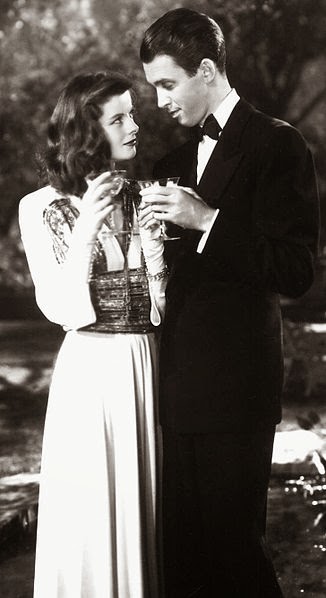
Katharine Hepburn plays Tracy Lord, the daughter of a well-to-do Pennsylvania family in the 1940 film. She's about to embark on a second marriage, this time to George Kittredge (John Howard). 

C.K. Dexter-Haven (Cary Grant), Tracy's ex-husband, unexpectedly shows up at the Lords' home on the eve of Tracy's wedding. He's accompanied by Spy magazine reporters, Macaulay 'Mike' Connor and Elizabeth 'Liz' Imbrie (James Stewart and Ruth Hussey) assigned to cover the event. 

An MGM film, it was directed by George Cukor and produced by Joseph L. Mankiewicz. It was the only time Stewart would work with Hepburn or Grant.
Joseph Mankiewicz didn't receive writing credit, but he virtually created the character played by Cary Grant out of two more minor male characters in the play (the ex-husband and a brother). He had to negotiate this idea, via Louis B. Mayer. Howard Hughes' approval had to be gained before production could begin. This article contains spoilers. 

Tracy: You're a kind of, um, writer, aren't you, Mr. Connor?
Mike: Sort of.
Tracy: A book?
Mike: Yes .....
 

Tracy: Dear Papa and Mama aren't letting any reporters in except for little Mr. Grace who does the social news. Can you imagine a grown up man having to sink so low.

The Philadelphia Story is one of the best of the golden age of the romantic comedies, the 1930s and 1940s. True to the Production Code and to romantic comedies in general, the film espouses that there is one true love for us, we can and should be together. 

Philip Barry created Tracy Lord with Hepburn in mind, honed while the play was in the theatre. The character is thought to have been inspired by heiress, Helen Hope Montgomery Scott and her family estate, Ardrossan on Philadelphia's Main Line.

Linda Seton, Hepburn's character in Holiday, was thought to have been inspired by Gertrude Sanford Legendre, a 1920's socialite and big-game hunter who went on to work during World War II for the Office of Strategic Services, predecessor of the CIA. 


Hepburn played Tracy Lord in the Philip Barry play on Broadway in 1939-1940
Pictured here with Shirley Booth, Van Heflin, Joseph Cotten, Vera Allen, Nicholas Joy
Playbill for the Sam S. Shubert Theatre: The Philadelphia Story 1939
Many romantic comedies start where at least one party is not interested in starting a relationship at all. He or she may be opposed to the idea of a relationship with that particular person. Romantic comedies changed as society changed, but the general formula tends to stay the same.

Film scholars and critics don't always agree where one genre starts and ends, what movies belong in what category. A Variety review of the day said that audiences would leave the theater with laughter on their lips and a tear in their eye.  

The Philadelphia Story features the ingredients that make a great romantic
comedy and a favorite of so many.

There is a good dose of the battle of the sexes.

C. K. Dexter Haven: I thought all writers drank to excess and beat their wives.
You know one time I secretly wanted to be a writer.

Tracy Lord: You haven't switched from liquor to dope by any chance, have you Dexter? 

George Kittredge: A man expects his wife to...
Tracy Lord:
Behave herself. Naturally.
C. K. Dexter Haven: To behave herself naturally. (George gives him a look) Sorry.

Tracy Lord: Dexter, would you mind doing something for me?
C. K. Dexter Haven: Anything. What?
Tracy Lord: Get the heck out of here.


Tracy Lord: You're too good for me, George. You're a hundred times too good. And I'd make you most unhappy, most. That is, I'd do my best to.


The movie includes some qualities of a popular subgenre, the screwball comedy. The Production Code limited much of what could be said and shown 1934- the 1950s. Movie-makers had to be creative to find new and innovative ways of communicating to the audience. 

Cavell says that Riches "are yet another means by which desire is heightened." Luxury is "essentially an expression of eroticism." Though it may seem slightly bewildering that such movies were popular during the Depression, luxury and its trimmings, the gorgeous flowing clothes and jewels, the mansions, lush and beautiful to look at can hold other meanings. 

Mike originally calls Tracy "just another rich, rapacious American female." Then he meets the beautiful Tracy Lord, lives in her home for a while and drunk on champagne, his views are different. He's now ready to forget Liz because he's hopelessly in love with Tracy.

Mike: When a girl is like Tracy, she's one in a million. She's, she's sort of like a, she's sort of like a...
Dexter: A goddess?
Mike: No, no. No, you said that word this afternoon. No. No, she's, she's sort of like a queen. A radiant glorious queen. And you can't treat her like other women.
Dexter: No, I suppose not. But then I imagine Kittredge appreciates all that.
Mike: Kittredge! Kittredge appreciates Kittredge. Ah, that fake man of the people. He isn't even smart.


Suggestive, clever, faster-paced language play can be found in the true screwball comedy.

Dexter: I suppose you'd still be attractive to any man of spirit, though. There's something engaging about it, this goddess business. There's something more challenging to the male than the, uh, more obvious charms.
Tracy: Really?
Dexter: Really. We're very vain, you know - 'This citadel can and shall be taken and I'm the boy to do it.'
 

Dexter: You look beautiful, Red. Come on in.
Tracy: Why? (She opens her eyes)
Dexter: No particular reason. A drink, maybe?
Tracy: I don't drink.
Dexter: That's right, I forgot.
Tracy: I haven't.

Censors dictated that Hepburn keep her eyes open while being kissed by Cary Grant,
even though the characters were now remarried.
This still photo was shown at the end of the movie.

Another feature often seen in the screwball comedy is poking fun at the rich:  the economic classes. Social satire has been a subject of some of the best comedy we've ever seen. Tracy's suitors in this film come from three classes. Who will she choose?

Mike: The prettiest sight in this fine pretty world is the privileged class enjoying its privileges.
 

Mike: You've got all the arrogance of your class, haven't you?
Tracy Lord: What have classes to do with it? What do they matter except for the people in them? George comes from the so-called lower class, Dexter, the upper. Well?

Mike:
Well...
Tracy Lord: Mac the night watchman is a prince among men, Uncle Willie is a... pincher. Upper and lower my eye. I'll take the lower, thanks.

Mike:
If you can't get a drawing room.
Tracy Lord: What does that mean?

Mike:
My mistake.
Tracy Lord: Decidedly. You're insulting!


In 1985, when Cary Grant presented James Stewart with his Honorary Oscar, he specifically mentioned their filming The Philadelphia Story. 

In 1941, Jimmy Stewart won the Academy Award for Best Actor for his work in Philadelphia Story. The film was nominated for six Oscars and won two. The other win was Best Adapted Screenplay for Donald Ogden Stewart.

Screwball comedies tend to have an outwardly scatterbrained female character who is really in charge of the situation, particularly in getting her man. [Popular examples I see include Susan Vance in Bringing up Baby, another Hepburn/Grant film or even Gracie Allen of Burns and Allen.] 

The only thing anywhere close to that in this movie is Elizabeth Imbrie and her relationship with Mike Connor.

Liz: Home after a hard day's blackmailing.... Mike's only chance to ever become a really fine writer is to get fired. (Dexter wonders if Liz wants to marry Mike.) She responds, "He's still got a lot to learn. I don't want to get in his way for a while."
Dexter: Suppose another girl came along in the meantime?
Liz: I'd scratch her eyes out, I guess, that is, unless she was going to marry somebody else the next day. 


The primary actors got together to create a radio version of the film for The Screen Guild Players.


The Philadelphia Story is also a remarriage story or comedy of remarriage, a term coined by philosopher, Stanley Cavell. This often refers to a set of films made during the Hays Code, the 1930s and 1940s. Divorced or divorcing characters could flirt with others then get back together. Cary Grant has been called the King of the remarriage comedies. Sometimes negotiations had to be done scene by scene, word by word to get a film approved. 

In 1946 it was reported that Grant was trying to buy Isabel Dawn's story Slightly Divorced, "a yarn about a divorced couple who have to live in the same house because of the shortage." Dawn was a Broadway actor and playwright.

C. K. Dexter Haven: Sometimes, for your own sake, Red, I think you should've stuck to me longer.
Tracy Lord: I thought it was for life, but the nice judge gave me a full pardon.
C. K. Dexter Haven: Oh, that's the old redhead. No bitterness, no recrimination, just a good swift left to the jaw.


Dexter: You might say Tracy and I grew up together.
Liz: You might also say you're C.K. Dexter Haven and you were Tracy Lord's first husband.

Dexter: Yes, you might.
Note: In the play, Tracy also says that they Grew up together, which is a pretty good way to sum up the two characters' transformation during the story.


Tracy: Two years ago, you were invited to a wedding in this house and then I did you out of it by eloping to Maryland...which was very bad manners... But I hope to make it up to you by going beautifully through with it now as originally and most beautifully planned.
 

After Dexter proposes...
Tracy Lord: Oh Dexter you're not doing it just to soften the blow?
C. K. Dexter Haven: No.
Tracy Lord: Nor to save my face?
C. K. Dexter Haven: Oh, it's a nice little face.
Tracy Lord: Oh Dexter, I'll be yare now, I promise to be yare.
C. K. Dexter Haven: Be whatever you like, you're my redhead.


"She was yar" or "She was yare." You now see both spellings.

Popular remarriage comedies include The Awful Truth, His Girl Friday, It Happened One Night, My Favorite Wife, The Lady Eve, That Uncertain Feeling, Woman of the Year, Adam's Rib and The Palm Beach Story

Cavell himself mentions inspiration in the structures of Shakespeare plays such as The Winter's Tale and The Tempest. With plots, is there much that's especially new out there besides how things are termed, grouped and categorized?

Film festivals have been built around this theme including 1950s & 1960s films such as Two for the Road or Phffft! with Judy Holliday and Jack Lemmon. 

There's been something of a baby boomer resurgence nowadays, with scholars' suggesting the movies belong to a Triangle or Triad subgenre. Look at Eternal Sunshine of the Spotless Mind and That Old Feeling. Meryl Streep may be the present-day queen with Mamma Mia, Hope Springs and It's Complicated.

While it is a comedy of remarriage, the marriage of Tracy's parents doesn't fare as well. Her father (Seth Lord/John Halliday) is having an affair. Their situation is presented as straightforward and realistically as the story, the time and the censors would allow. He refuses to take responsibility for his choices. He has some insight but no apparent plan to change as Tracy and Dexter have changed. 

Seth Lord: What most wives fail to realize is that their husband's philandering has nothing whatever to do with them.
Tracy Lord: Oh? Then what has it to do with?
Seth Lord: A reluctance to go grow old, I think.
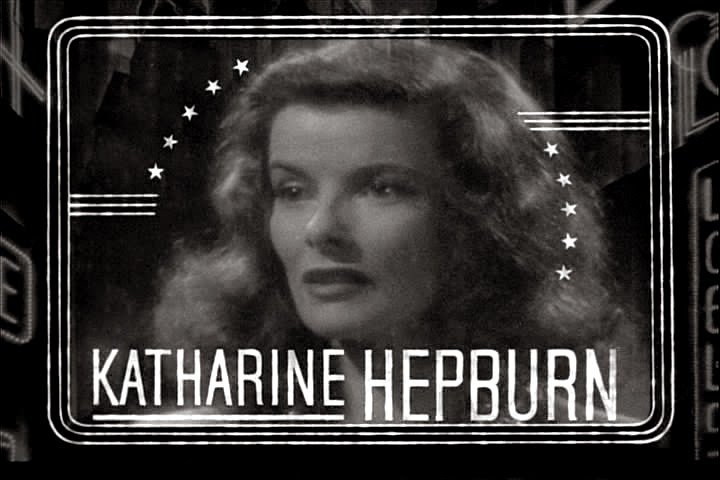

No longer 'box office poison,' The Philadelphia Story
was one the top grossing films of 1941

This is the kind of film that stands up well to re-watching, if you watch it multiple times, you get more out of it. Keeping in mind the time it was made, the audiences for whom it was made makes it all the more enjoyable. This was Hepburn's break-out role, back from having been called box-office poison. 

The Philadelphia Story was selected for preservation in the United States National Film Registry in 1995. 

In his Ten Commandments for Studio Readers used 'to facilitate story selection,' Irving Thalberg [MGM producer] noted "Read at least two newspapers daily. Photoplays sell best which are based on timely topics." The Philadelphia Story was written in the late 1930s.

"Sometimes what has become objectionable behavior can date a film as much as its characters' clothes. Dexter pushes Tracy to the ground, and a modern audience thinks domestic abuse. Connor lights one cigarette after another and we think lung cancer. ... 

"Eventually someone will be watching us. Irving Thalberg once predicted, 'The movies will be the best record of how we once lived.'" 
--  The ABCs of Classic Hollywood by Robert Beverley Ray studies a group of classic films, including Philadelphia Story. Such is part of the value of The National Film Registry. 

"In the opening scene Tracy Lord is throwing her husband, CK Dexter Haven out of the house golf clubs and all. When she breaks one of the clubs over her bended knee she has gone too far. He comes back to push her in the face knocking her right on her backside.

"'Oh, I loved it,' Kate said. 'Just what Tracy -- and I -- needed.' The last time moviegoers had seen her Katharine Hepburn was running off with Cary Grant at the end of Holiday. So she thought this scene would be as much fun for her fans as for those who didn't like her.  'Although I must tell you', she said, 'I truly believed that everybody still adored me, that it was nothing but bad material that made me box-office poison.

"'In some ways, Kate said, 'The opening of this  picture showed that running off with me could be fun and exciting, but that living with me was clearly no holiday. Life imitating art!' she said, laughing hard."
-- Kate Remembered by A. Scott Berg

This movie is often mistaken, because of the title alone, for the 1993 Tom Hanks, Denzel Washington film, Philadelphia.

Filmadelphia: A Celebration of a City's Movies (2006) by Irv Slifkin includes many movies that are set in Philadelphia.


Sources not mentioned above:
Better Left Unsaid: Victorian Novels, Hays Code Films, and the Benefits of Censorship (The Cultural Lives of Law)

Pursuits of Happiness: The Hollywood Comedy of Remarriage  by Stanley Cavell

Joseph L. Mankiewicz: Critical Essays with an Annotated Bibliography and... By Cheryl Bray Lower, R. Barton Palmer

Romantic Comedy: Boy Meets Girl Meets Genre by Tamar Jeffers McDonald 

Romantic Vs. Screwball Comedy: Charting the Difference by Wes D. Gehring [Discussions include "The seemingly paradoxical importance of tears to this form of  comedy," and "the romantic comedy's habitual association with female audience members."]

The Philadelphia Reader edited by Robert Huber, Benjamin Wallace


Someone just told me about the (fictional) book Dating Cary Grant. Old movie fans will recognize the character names, several are from Philadelphia Story. It sounds like a cute story.

Take a look at  MGM: Hollywood's Greatest Backlot


Related Links of Interest:

Was Katharine Hepburn Box Office Poison? Or Bette Davis or Joan Crawford?

Katharine Hepburn and Cary Grant in Holiday

Bringing Up Cary Grant and the Oscars

My Favorite Wife Cary Grant and Irene Dunne, Santa Claus shows up early and the 1962 remake that never was, Something's Got to Give with Marilyn Monroe, Dean Martin and Cyd Charisse

A Trophy for James Stewart, Mr Stewart Goes to the Oscars 

15 Songs for Remarrying your first spouse Remarriage to a former spouse

Films inducted into The National Film Registry; what will you nominate?


This is my Contribution to the Romantic Comedy Blogathon, hosted by Lara at backlots and Vince at Carole & Co.

some images from Wikimedia Commons 

Thursday, March 13, 2014

Hands in Film Fashion Surrealist Influences

Fashion and hands forever linked

The human body has always served as an artists staple subject matter. Styles
Bejeweled hand clasp
on a swimsuit cover up
Fashion show in The Women 1939
change and the depictions are different.

One of the most public and still most personal body part is the hand. We may be adorning our own with rings and bracelets or the very latest in nail art. Put a ring on it. Hand work in art and fashion is prized.

Religions join hands in ceremonies, hands are seen in iconography, we pray, shake hands, wave hello and goodbye. Palmistry is used to foretell your future, whether you're a believer or not. 

The Beatles will forever want to hold your hand. It makes them feel happy inside. Delightful as it would be to hold hands with any of The Beatles (is there a place where I can sign up?), holding hands with someone can be one of the sweetest, most loving, even most comforting things we do.

The hand and heart is popular in folk art even as a cookie cutter design. What the hand is doing, how it's positioned, as Fonzie knew - be it thumbs up or down, can be vitally important.


Rosalind Russell won't miss a thing in this dress

Fashion designers have incorporated the hand into their clothing and accessories for years. Influenced by Surrealism, Italian fashion designer Elsa Schiaparelli incorporated hands, among other things into her accessories in the 1930s. 

Her hand themed buttons and belts are museum pieces and collectors items now.
The Women
Gloves with golden extensions

We can't ignore Cedric Gibbons' contribution to The Women. As art director, his set designs added glamor, ambiance and just the right environment to each scene.

In The Women, major developments happen early on in a scene with a manicurist. 

The theme of fingers, claws and Jungle Red nail polish carries throughout, so it's fitting that Gibbons created an outstanding piece of glowing hand sculpture to catch our eyes. 


The spa and department store sets were said to take up several rooms alone. Why couldn't Mary's husband keep his hands off of Crystal??

Hands, and a nod to Schiaparelli's designs of the day, also served as inspiration for the costume designs in films such as The
My department store
doesn't have
a display like that
Women
(1939) and 1942's The Man Who Came to Dinner


Adrian produced outfits for a Technicolor fashion show in the middle of black and white movie The Women, much to the chagrin of director George Cukor. 

Like The Wizard of Oz in the same year, The Women was a black and white film that had a color segment included. Though some find it jarring, most viewers adore the fashion sequence.

He was costume designer for the entire film.  Rosalind Russell wore an eye-popping three-eyed dress early in the film. This served to define the character but also gave a nod to the Surrealist fashion movement. 

Norma Shearer Photo
Schiaparelli designed a line of gloves with elaborate ruffles and even mock fingernails. Gloves with 3-D nails or claws can be found today, be they fancy dress costume-quality or high fashion designer quality with the price tags to match.

Some of the film's fashion show is online. The Women (the original from 1939 particularly) is a great film that's pretty regularly shown on television, be it PBS or channels such as Turner Classic Movies, TCM. 

Just some of the stars are Norma Shearer, Joan Crawford, Rosalind Russell, Paulette Goddard, Joan Fontaine, Lucile Watson, Butterfly McQueen and Mary Boland. 


One of Schiaparelli's famous accessories was a simple silk evening belt with a plastic hand clasp from the designers fall 1934 collection. "The wearer is literally embraced around the waist by the belt," they said.
Ann Sheridan
The Man Who Came to Dinner
Orry-Kelly was costume designer on The Man Who Came to Dinner. Ann Sheridan wears a blouse with hand-shaped buttons. 

She and her pretentious behavior frustrates the characters played by Bette Davis and Monty Woolley.

Some reviewers of the day referred to the garments as faux Schiaparelli gowns. Do you remember other movies with outfits like these?

Schiaparelli created a silk dress with a larger-than-life hand-painted lobster on the skirt for Wallis Simpson's trousseau when she was to marry King-Emperor Edward VIII. 


The lobster motif is reminiscent of a  brooch Joan Crawford wore in, I believe, Mildred Pierce. Fashion and accessories, especially for those who could afford the very best, was getting more surreal in the 30s and early 40s.


The Man Who Came to Dinner Movie Poster


The collections of designers Rei Kawakubo of Comme des Garçons in 2007 and Hussein Chalayan in 2010 have incorporated hands in unique ways. 

Kawakubo's hands are more decorative while in Chalayan's looks they may serve to be utilitarian as well. (This is based on seeing their partial collections.) Jewelry designer Margaux Lange is one who incorporates parts of the iconic Barbie doll into her jewelry.

How about the hand in architecture? The entrance to the car park of Estonian State Opera at the Estonia Theatre in Tallinn has barrier gates. When you've paid for admittance they raise and allow you inside. Some of the gates are fashioned in the shape of an oversized hand holding a conductor's baton.  
Barbra Streisand Fine Art Paper Print
from The Owl and the Pussycat, with George Segal 1973
Not quite the same thing, but a famous costume


The book, Architecture and Film has a section on Cedric Gibbons. This is now available on Kindle. Film buffs will enjoy how many eras are discussed and historians, especially those who are makers and builders will really love it. Who built Mr. Blandings' Dream House?

George Cukor, Master of Elegance: Hollywood's Legendary Director and His Stars by Emanuel Levy is just one where you can the director's feelings about the technicolor fashion show sequence. Imposed by the producers, Cukor felt that "it made the black and white footage that followed look bad." Since color was a novelty in 1939 it was inserted at least partly to get added attention for the movie.

Shocking Life: The Autobiography of Elsa Schiaparelli Her autobiography is on Kindle. Are any of her pieces at your local museum?

Chromatic Cinema: A History of Screen Color is a good guide to early use of color in film.


Related Links of Interest:

Philadelphia Museum's Shocking! The Art and Fashion of Elsa Schiaparelli

Check out the Lobster Dress at The Philadelphia Museum

Remember Max Factor SophistiCat and Schiaparelli Perfumes

Comparing The Unknown & Edward Scissorhands; Lon Chaney and Johnny Depp

Six movies where characters have possessed hands 

It's spreading New Viral Art

Hand Shadows Lamps and Shades Customize or Create new A little bit of light or a lot
 Palmistry Bagettes Bag Wristlet Purse
Palmistry Bagettes Bag Wristlet Purse by EndlessVintage
Browse Palmistry Bagettes Bags online at Zazzle.com

Sunday, March 2, 2014

Katharine Hepburn and Cary Grant go on Holiday

Katharine Hepburn and Cary Grant
go on Holiday


Katharine Hepburn wanted to play Linda Seton in the film version of Holiday. Next, she felt she was right for the role of Scarlett O'Hara in Gone With the Wind.  

Failing that, she'd work even harder to get The Philadelphia Story made. Holiday is funny, smart, sweet and thoughtful. It isn't known or acknowledged as it should be.

Katharine Hepburn was familiar with the role 
of Linda Seton in Holiday. She'd understudied the part on Broadway in 1929. There was no opportunity to be onstage since Hope Williams was healthy during the run of the show

Hepburn did have one chance later to play the role on stage when the play reopened in the Riviera Theater at Ninety-seventh Street and Broadway in preparation for a cross-country tour.

"Arthur Hopkins watched her from the back of the theater and he thought her performance was 'even more compelling than any he had seen his leading lady give.'" Hopkins directed, produced and staged the play.
-- Quote from Katharine Hepburn: A Remarkable Woman, Anne Edwards

1935 Rotogravure Katharine Hepburn
"Those old meanies who whispered
that the Hepburn crown was slipping
have had to eat their words." Original Rotogravure
Philip Barry, who wrote the play was a fan of Hepburn's. He would also write The Philadelphia Story seemingly with Hepburn in mind for the part of Tracy Lord. Julia comes home from a vacation with a man, Johnny Case. They're engaged to be married. 

They could hardly be more different. Linda and Julia's father doesn't approve.
Holiday Movie Poster
1930 Ann Harding, Mary Astor,
Edward Everett Horton,
Robert Ames, Hedda Hopper
Turns out that he is just right for Linda, but she will not stand in the way of Julia's happiness if this is really what her sister wants.


Holiday had been produced as a film once before in 1930. Ann Harding was Linda and Mary Astor, Julia Seton respectively. Robert Ames was Johnny Case.

Ann Harding received an Oscar nomination at the 4th Academy Awards for her performance as Linda Seton in Holiday. Her competition for Best Actress that year was Marie Dressler, Marlene Dietrich, Norma Shearer and Irene Dunne. Dressler won the award for her work in Min and Bill. 

Interestingly Edward Everett Horton played Johnny's friend Nick Potter in both the 1930 and 1938 films. 

Donald Ogden Stewart played Potter on Broadway. He would go on to write the screenplay for the 1938 movie that Cukor directed.

In late 1937 Louella Parsons was saying Irene Dunne and Cary Grant, who'd been successful in The Awful Truth, would team up again in a film production of Holiday and that Leo McCarey would direct. The public wanted a reunion of the trio. When it did occur 1940s with My Favorite Wife, they had another major hit.


Katharine Hepburn Cary Grant Holiday
Knowing how to fall is a big part of being a successful acrobat

I liked this comment by John Houseman about Katharine Hepburn's acting style and successful actors in general.

"In working with Hepburn, John Houseman wrote many years later, 'I made a fascinating discovery about star quality in general and hers in particular.... In every star role there are one or more opportunities for such peaks. If not they must be created....'

"The somersault with Grant is such a peak, designed to emphasize Hepburn's beauty and adventurousness, giving the spectators a moment of pure voyeurism, when they seem to glimpse the star enjoying herself.  

"But if the joyful performance-within-a-performance in the upstairs room allows
The Philadelphia Story
George Cukor,
Katharine Hepburn,
Cary Grant
Hepburn to show off in a charming way, subsequent developments give her an opportunity to behave like a straightforward actress. ... actorly moments that reveal the conflict between Linda Seton's public and private self. 

"Sometimes her technique is localized in a line of dialogue as when she wishes Johnny Happy New Year in a voice that quavers with chagrin d' amour."
-- Acting in the Cinema, James Naremore 

"When Holiday was finished George Cukor threw a traditional end-of-shooting party. 'I stole the old Holiday test from RKO and ran it for the guests. I laughed when I saw myself.

"I led the laughter and everyone just fell over, Cary, George everyone, laughed themselves sick. I was so terrible! It was heartbreaking to see how eager, how hard I was trying to impress -- too eager. I turned to George and said, 'Oh God why did you hire me?'"  
-- Kate: The Life of Katharine Hepburn, Charles Higham

Reception:

It received decent critical reviews particularly praise for the actors' performances. Film was a great form of escapism during the 1930s. 

Often romantic and screwball comedies also presented story lines that mocked class or snobbery. Though the characters may have lived in opulent surroundings somehow they managed to send a message, to make the viewer feel good about themselves. A film like My Man Godfrey really championed the poor and working class.

One reason suggested that Holiday didn't do as well as it might is that it was a 1920s play released during the heart of the Depression. Grant's character had gotten through college working in a factory, driving a garbage truck. But he essentially walks away from a job offer because he wants to earn enough money to take an extended holiday. The term holiday was sometimes used as a euphemism at that time for time off due to a loss of a job.  

Relevance to Present Day:

The choices being made by the characters, to go after the most money possible or scale back and follow a life's passion is of true relevance to our present-day when we see people in high paying jobs quitting to pursue other interests. Vocation vacations have been around for a while. 

Do you want to do something that's more socially relevant or chase after the most money you can acquire? Do you want to follow your bliss? Which is the best role model for your kids? It's in the news all the time. A 1929 play, a 1938 film lives in 2014 society.

If any of you has reasons why these two should not be married,
speak now or forever hold your peace.


The 1930 version with Ann Harding and Mary Astor


Family Relationships:

Comparisons between the sister relationships in Holiday and Little Women have been explored by critics and film historians. In 1933 Hepburn had starred as sister Jo alongside Joan Bennett, Jean Parker, Frances Dee in RKO's Little Women, also directed by George Cukor.

Lew Ayres in Johnny Belinda
In Holiday, Linda Seton had identified with her mother. Her memory lived in a single room in their big house, a playroom that she'd decorated for the children. 

The sweet, heart-tugging brother Ned, played by Lew Ayres would go on to play Dr. Kildare on radio and films alongside Lionel Barrymore's Dr. Gillespie.

Linda and her brother Ned (Lew Ayres) knew they weren't the children their father had hoped for. Julia was more like her father. While she and Johnny were attracted to one another, they were so different that they probably wouldn't have had much of a future. 


Holiday has a timelessness in its portrayal of the relationships: family, friends and romantic. It's intelligent, poignant and witty. You're not presented with bad people as much as those who are maybe immature (sister Julia) or stuck in their ways (Henry Kolker as father, banker Edward Seton). The father is the steadfast, snobbish chap offered up ready to be deflated in many a Depression-era film. 

The playroom is unlike any other room in their museum of a house, so called by Johnny. The room is Linda's safe place. She brings Johnny inside and he keeps returning. He stays there with Linda even when his new fiancee, Julia tries to insist that he join her back at their big engagement party on New Year's Eve. He finally asserts himself.

It's a good film for couples who are dating. If you're having second thoughts it's okay to slow down and take time to think things over, get to know each other a bit more. Get to know yourselves.


While there's a relatively happy ending, it doesn't solve all the family's problems. The characters have to work on their relationships. So much of the film revolves around family and expectations. The father and what he wanted his children to be, all reflecting back on himself. 

On to Gone With the Wind??

After Holiday Hepburn had her eye on a particular prize. Cukor was signed by David O. Selznick to direct Gone with the Wind. Hepburn desperately tried to convince them that she was right for the role of Scarlett O'Hara. Selznick disagreed. He looked at that old box office poison reputation, thinking it would hurt the movie.

"Kate confronted Selznick directly and, after an hour of her insistence he offered to screen test her. Kate refused telling him, 'You know what I look like on screen, you know I can act. And you know this part was practically written for me. I am Scarlett O'Hara. So what's the matter?'"

"'All right, I'll tell you,' Selznick said, 'I just can't imagine Clark Gable chasing you for 10 years.'"

George Cukor was replaced on Gone with the Wind by Victor Fleming after 3 weeks of shooting. Differences of opinion between Cukor and Clark Gable, cast as Rhett Butler have been generally though to have precipitated the change. A much more likely reason would be Selznick's feelings that Cukor was undermining his control. 
-- Katharine Hepburn: A Remarkable Woman, Anne Edwards

It was after this that Hepburn would take a break. With the help of Howard Hughes, she would get the rights to Philip Barry's play, The Philadelphia Story and begin appearing in the play. 

The role of Tracy Lord had been written especially for her by the playwright. Hepburn could not be shoved out of the role she wanted in this picture. When the film version is released in 1941, reviewers are saying that no one should call Ms. Hepburn box office poison anymore.


Related Pages of Interest: 

Charles Boyer receives The Gift: When our children don't turn out like we are

Katharine Hepburn is Box Office Poison??

Cary Grant, Katharine Hepburn & James Stewart in The Philadelphia Story 


My Favorite Wife: Cary Grant and Irene Dunne, nontraditional Holiday Movies


Sources:

Me : Stories of My Life by Katharine Hepburn
 
Kate: The Life of Katharine Hepburn by Charles Higham

Katharine Hepburn: A Remarkable Woman by Anne Edwards
Irene Dunne: First Lady of Hollywood by Wes D. Gehring

Acting in the Cinema by James Naremore


Life's a Drag! Paper Dolls (Dover Celebrity Paper Dolls)

Men dressing as women, women dressing as men—even a woman dressing as a man dressing as a woman. Features 17 dolls and 30 costumes.


** I've been unsuccessful finding a scan of the original article and list from the 1938 Hollywood Reporter magazine. Some people give slight variations of the stars, sometimes adding Shirley Temple to the list.
Images from Amazon.com unless noted differently

***About links: Please note that links will open in separate windows for your convenience. You can close them and go back to this blog article in its original window.
Major updates to this page will be noted with a revision date.     

Small screen captures used to discuss significant scenes in and promote a specific a program or film. 

Friday, February 14, 2014

National Film Registry Save the Films- These Amazing Shadows

National Film Registry
 These Amazing Shadows


At the 45th Academy Awards The Godfather received
Francis Ford Coppola
The Godfather Signed
11X14 Photo
three of the ten Oscars for which it was nominated. Albert S. Ruddy took home the Oscar for The Godfather Best Picture. Mario Puzo and Francis Ford Coppola won Best Writing Adapted Screenplay. 


In the category of Best Actor in a Leading Role, Marlon Brando won but declined the award. Today the film is influential, revered by many and seen as a classic.

These Amazing Shadows, a 2011 production created, written and directed by Paul Mariano and Kurt Norton, showcases the Film Preservation Act and the creation of the National Film Registry. 

We see The Godfather held up as an example. A 1972 film, is recent if you look at the history of film in general. 

The original negative of that film was in bad shape. It isn't just age, mishandling or the material a film is printed on that takes a toll. The more popular the film the worse condition the original negative will be in the more copies that have been made. Who is there to do the necessary restoration when a film has "been loved to death?" 

So if a relatively recent, award winning classic film like this could have been deteriorating what about all the other films that came before, particularly those lesser known and not as prominent?  


All About Eve Movie Poster (1950)
(Bette Davis)(Anne Baxter)(George Sanders)(Celeste Holm)(Gary Merrill)(Thelma Ritter)

In 1988, the Film Preservation Act was passed and, through the Library of Congress' National Film Preservation Board, brought about the National Film Registry. It's impressive to know that an arm of the US Government is saying that film is an important part of our history. The Library of Congress will be involved and it's our duty to restore it and see that it is recognized.

"It's a different form of honor than Academy Award," said author and film historian Leonard Maltin. "It's a more cumulative retrospective honor. It says your film has stood the test of time."

"The Academy Awards preserve the consensus within the industry at the time. Sometimes history proves them right. Very often history proves them wrong," notes Film critic, blogger and author, Mick LaSalle.

Films, their respective actors, directors and other professionals whose work did not receive an Academy Award may get the more lasting respect deserved when honored in this way.

The Film Registry began choosing films in 1989. Their criteria is that the film must be, "Culturally, historically or aesthetically significant." 

Films have to be at least 10 years old. They choose 25 films per year beginning with a solicitation
Little Caesar Edward G. Robinson
of public ballots. 


The documentary touches on certain key topics while covering a lot of ground in about an hour. Censorship, the roles of women, African Americans and Native Americans in film. 

We see the diverse types of films on the registry; from old and newer big screen films to documentaries, newsreels and home movies. 

Perhaps most of all, the documentary shows the importance of preservation and restoration of all of this, our history.

These Amazing Shadows: The Movies That Make America is a good documentary and it covers a lot of ground. PBS may cut it down from its original time which is about 90 minutes. I really like documentaries and most that I watch are between an hour 45 minutes and two hours. If you have Amazon Prime you get unlimited viewings.

Included are discussions on movies like Topaz a 1945 documentary film showing life in the Japanese internment camps. The people on board to narrate the different topics are interesting. They may be associated with The Film Registry and may not. 

Actor George Takei is among those discussing Masaharu Tatsuno's film, Topaz. Takei and his family were among those Japanese Americans who were interned for no reason but that they were of Japanese heritage. The Takei family was first taken to the Rohwer War Relocation Center in rural southeastern Arkansas.

Abraham Zapruder's famous home movie of the assassination of John Kennedy was inducted in 1994. 

Historical films, art films even Cold War propaganda are included. How about the bumper film that came between features at the drive-in, Let's go to the Lobby. There is discussion of the 1980s debate of colorization.

B and Z movies are included. Invasion of the Body Snatchers was inducted
Kevin McCarthy, Dana Wynter
Carolyn Jones
Invasion of the Body Snatchers
in 1994. 


There's a long history of writers and directors making a message more palatable or getting through the walls of censorship by cloaking it in the world of fantasy or science fiction.  

Invasion of the Body Snatchers has critics and film-goers debating whether or not it has an intended anti-McCarthy message as it was released in 1956 during the height of the Red Scare.   

What is agreed on is that the creators of the film didn't do much to stop people's associating the two.


I just wrote about Joseph L. Mankiewicz's People Will Talk from 1951. It's not science fiction but is a film that appears to pretty clearly tackle the issues of their day. 

"These Amazing Shadows reveals how American movies tell us so much about ourselves... not just what we did, but what we thought, what we felt, what we aspired to, and the lies we told ourselves." 
-- from the film web site

Cary Grant and Ingrid Bergman, Notorious 1946
[public domain img from trailer]
Censorship blocks the free expression of an era talking to another era, the documentary reminds us. When you watch a movie from the past you're involved in a dialogue.

"Every movie that's popular captures the ideas, something popular at the time. Very often the ideas that they capture make them
acceptable to the public are lies."
Mick LaSalle

Once in a while when watching old movies with friends someone will pipe up, "How could they do that?! How could they say that?! I guess in 1940 that was funny to people?" The watching brings good discussion, an examination of ourselves, our past as it really was, how and who are we now? What we want to hide is probably one of the most important things to show future generations. Learn not to repeat.

Boyz N the Hood Movie Poster 1991
Laurence "Larry" Fishburne Ice Cube
Cuba Gooding Jr. Nia Long Morris Chestnut
D.W. Griffith’s Birth of a Nation was inducted into The Film Registry in 1992. The Searchers, in 1989. John Singleton's Boyz n the Hood (inducted 2002). This is our history and it's important to see where we came from and where we are going. 

These films show something about race relations in the US. Look at other mainstream films for the way minorities are portrayed if they are included at all. This tells you something, too. 

You're hard pressed to find a hero in a film who wears glasses, let alone a hero who has any sort of disability. What's the predominant age, weight, gender? Who is underrepresented?

The important role of women in film making is discussed with mention of early female directors such as Lois Weber and Dorothy Arzner. The 1939 film, The Women was inducted in 2007. Directed by George Cukor, all actors were women, it's said that even every animal featured was female. Authors of any books shown were female.

Lois Weber's contribution in the Film Registry is the 1916 Where are My Children is included in the set Treasures III: Social Issues in American Film 1900-1934. Her film was inducted in 1993. We'll learn how similar we are to those who came before us, and maybe have even more respect for those who came before us.

A rare unedited version the 1933 Barbara Stanwyck film Baby Face was
Babara Stanwyck, from Baby Face trailer
public domain, WikiMedia Commons
discovered and is compared to its edited and better known counterpart. 


They noticed that they had two negatives of the film, one was larger -- it was the unedited version. The differences between the two tell us about film making, about censorship and our history. 

The film was inducted in 2005 and having both versions makes it even more valuable. The Production Code also known as the Hays Code was just coming into Hollywood in the early thirties. 

The film is described as being about an attractive young woman who uses sex to advance her social and financial status. The censors would cut several minutes before it would be shown.

It's a funny time now as we're seeing so many television shows begin with disclaimers. Don't even talk about the PBS programs about native peoples in far off lands, I saw a show where mannequins' body parts digitally obscured. Not sure what's going on today. At the same time the freedom to broadcast has never been as it is today, particularly when you include the Internet. 

Cold War public safety propaganda films are on the Registry. Duck and Cover was produced by the federal government's Civil Defense branch. It was directed primarily at kids showing what to do in case of a nuclear attack.


Also included is the dramatic House in the Middle. It's a 1954 film implying that you may survive a nuclear attack if your yard is clear and your home always has a fresh coat of paint. 

The sponsor is The National Clean Up-Paint Up-Fix Up Bureau. That sounds like a mysterious group of people my Mom & Dad would've threatened me with when I had a messy room. But turns out the Bureau is actually part of the National Paint, Varnish and Lacquer Association. 

Freaks 1932- Movie Poster Inducted 1994
Checking out who created and who is repeating or publicizing the information you're hearing is important to this day. A fancy sounding name may be a cover for something else.

The segment on colorizing films is interesting. Ted Turner purchased the film studio MGM/UA Entertainment in 1986. He set about colorizing some of the black and white classics.

"The last time I checked, I owned the films that we're in the process of colorizing," said Ted Turner. "I can do whatever I want with them, and if they're going to be shown on television, they're going to be in color." 
-- Los Angeles Times October 23, 1986

A rationalization was that colorizing the films would get a whole new audience, people who wouldn't be open to viewing a black and white movie. Apparently sales of some colorized movies showed it to be true, with VHS tape sales and rentals. The cash register was winning.

Film professionals, past and present went before Congress, appealing to them to
Snow White and the Seven Dwarfs
11x17 Movie Poster
stop the colorization. The value of film, America's history, was stressed. Roger Ebert, James Stewart, John Huston, George Lucas and Woody Allen were among those who testified. In 1988, the Film Preservation Act was passed and through the Library of Congress' National Film Preservation Board, brought about the National Film Registry.


The irony in this is that Turner's own television channels, particularly Turner Classic Movies, TCM, are much lauded today for its showing of classic movies uninterrupted and in as original a version as possible. 

On TCM viewers may also see old newsreels, travelogues, short features and the occasional interview or tribute. Lovers of old black and white films gravitate to channels such as TCM. 

The Film Registry has art films and those that honor and recognize early sound technology, like Gus Visser and his Singing Duck. Interesting that some of the earliest films included animals. Why didn't this duck ever become a star?
Who could have imagined this film would survive? 


Films are, as they said, our country's family album. Through film we have stories to tell, how we were as a country, what we valued then and now. And we do value our history. In 2009, Michael Jackson's Thriller became the first music video to be inducted into the Film Registry.

Rocky Horror Picture Show 1975 Tim Curry 8x10 inducted 2005

Among the impressive group people interviewed on this film you'll see Rob Reiner, Peter Coyote, Tim Roth, Wayne Wang and John Waters. They talk about how their lives were changed by films. 

I was so impressed with those who work for and with the National Film Registry, those who work to restore the films, film critics and historians, even the Librarian of Congress was interviewed. These people are dedicated to what they do, they're serious and passionate about the art form and they're fans themselves. We get a peak at their discussion process, how they debate which nominated films should be inducted. 

One film to watch would be the 1920 American Red Cross documentary Heroes All. At the centenary of World War One, it would be a good time to view this movie which examines wounded WWI soldiers who are receiving treatment at Walter Reed Hospital. They also show Washington DC as it was at that time. It's noted that some Red Cross cinematographers went on to careers in Hollywood. This Red Cross Bureau of Pictures production has historical significance and much more.

When I worked at a library a friend came back from an ALA conference wearing a T-Shirt. It said something like, "Visit your local library. There's something there to offend everybody." That's kind of the job of a library regardless of the medium, books or film. Gather the past, be the curator. 

There's an interesting article in a December 2013 edition of The Hollywood Reporter about the politics behind the National Film Registry. There are misunderstandings among some about the Film Registry, including that it is a list of popular films.

"The October government shutdown that led to the furlough of federal workers had an unusual side effect: It canceled the annual meeting of the National Film Preservation Board for the first time in its 25 years of existence.

"Instead, the 44 members (20 active, 22 alternates, two seats vacant) who help decide which 25 films will be added to the 600 titles on the National Film Registry met via email. .... 


"'This is not a popularity contest,'" says National Preservation Board chairman and former MGM film exec Roger L. Mayer. "'It's an attempt to tell people about the history of film and the way film portrays history.' ....

"Of the 42 active board members, 30 are men. The members are submitted by the organizations (including the MPAA, AFI, AMPAS and DGA) that hold chairs on the board, while some at-large members are invited directly by the Librarian. After meeting, each board member submits his or her final 25 picks. 

"Then Billington -- sworn in as the 13th Librarian of Congress in 1987 and the only person to ever have this role and responsibility -- finalizes the list.

"'"We are the sole custodians of the copyright composite of the most creative people in human history," Billington says. "An ordinary person assumes that if it's a museum or it's in an archive, it's going to be there forever. They assume it's something that somebody else will do -- well, we're that somebody else.'"
 -- excerpted from The Hollywood Reporter December 6, 2013 

The National Film Preservation Board Films Chosen 1989-

Learn how to nominate a film to The Film Registry

A list of films that are Not Yet Named, give you some ideas (from the Film Preservation Board)

Celebrity Family Members/Spouses with Hollywood Walk of Fame Stars near one another

Barbara Stanwyck & Robert Taylor Their Wristwatches & Sapphires, wedding & delayed honeymoon


*About links: Please note that links will open in separate windows for your convenience. You can close them and go back to this blog article in its original window.